By Nicole Junkermann, founder of NJF Holdings
For much of my investing career, the direction of travel seemed fairly clear. Money was becoming more international, companies could sell almost anywhere, and supply chains kept getting longer. Tech made distance less troublesome. A founder in one country could build a team in another, raise money somewhere else and find customers around the world.
There were borders, obviously. Investors still worried about politics. But the broad assumption was that the world would keep becoming easier to connect.
I’m no longer sure we can make that assumption.
Look at some of the questions facing businesses today, and you find yourself looking at a map. Ships have to get through the Red Sea and Suez. Oil and LNG leave the Gulf through the Strait of Hormuz. Taiwan remains central to the production of advanced semiconductors. Europe has spent the years since Russia invaded Ukraine rethinking where its energy comes from.
Even the internet has a geography. Almost all international data traffic travels through cables laid across the seabed. They come ashore at particular places, in particular countries. Damage a cable, close a shipping route or lose access to a supplier and distance suddenly becomes very real.
AI makes the point particularly well. We talk about models and the cloud, which can make the industry sound almost weightless. Then someone has to build the data centre. It needs land and huge amounts of electricity. It needs water or other forms of cooling. It needs access to a grid that can cope with it. All of that has to happen somewhere.
The physical world never went away.
For investors, I think this changes the way we need to look at companies. It isn’t enough to know whether a business has a good product and a large market. I want to understand where its important suppliers are. I want to know where its energy comes from, how exposed it is to one country, and what happens if a route it depends on becomes unreliable.
Twenty years ago, some of those questions might have appeared fairly late in an investment discussion. Today they can change the investment itself.
Governments have reached the same conclusion but from a different direction.
Semiconductor plants are now matters of national policy. Countries are spending heavily to secure energy and critical minerals. Foreign investment in certain technologies gets examined on security grounds. Ports, power networks and communications infrastructure can quickly become political issues.
This has also changed the role of capital.
I find the Gulf especially interesting in this respect. It is still one of the world’s great energy centres, but that description now tells you much less than it once did. Gulf states are investing in technology, sport, infrastructure, research and financial services at home, while their sovereign funds have become major investors abroad.
They have also built relationships in several directions at once. Europe matters. So does the United States. So does Asia. This isn’t a small distinction at a time when larger powers are asking other countries to choose sides more often.
I’ve always been drawn to investing across countries. The simple reason is that good founders and good businesses aren’t confined to the places you already know. Some of the most interesting opportunities appear when an idea moves from one market into another and changes along the way.
There is a harder reason to value those connections now.
We’re living through a period in which countries are becoming more protective. Some of that is understandable. Europe learned a painful lesson about relying too heavily on Russian energy. Governments have good reasons to worry about control of important technologies. A company would be foolish to ignore a serious weakness in its supply chain simply because fixing it costs more.
But we should be careful about where that logic leads.
If every country responds to uncertainty by pulling back, the result will be a poorer and probably less stable world. You can reduce one risk and create another. Businesses lose markets. Researchers lose collaborators. Founders find it harder to reach capital. Countries that speak less to each other usually understand each other less as well.
This is where I think bridge builders matter again.
I don’t mean that in an idealistic sense. Investors aren’t diplomats and a venture fund isn’t going to fix relations between governments. But people who spend years working across countries do build something useful. They learn whom to call. They understand how decisions get made in different places. Trust develops between people who might otherwise never have met.
Money can help create those relationships because an investment is rarely just a transaction. Done properly, it can last for years.
I have seen that across Europe, the United States, the Gulf and other markets where I’ve worked. The differences between them are real. Pretending otherwise doesn’t help anyone. But neither does assuming that difference makes cooperation impossible.
In some ways, smaller countries understand this particularly well. They don’t have the luxury of believing the world will organise itself around them. They have to trade widely, maintain relationships with countries that don’t always agree with one another and find areas where their own interests overlap with somebody else’s. Qatar, the UAE and Singapore have each done versions of this in very different circumstances.
Investors can learn from that instinct.
I don’t think we’re heading back to a world of closed national economies. There is too much trade, knowledge, capital and technology moving between countries for that to make much sense.
I do think the easy assumptions of the last few decades are disappearing. Where something is made matters. Who controls it matters. The route between producer and customer matters. So does the relationship between the countries at either end.
That makes investing more complicated. I’m not sure that’s a bad thing.
We probably became too comfortable with the idea that efficiency could solve almost everything. The cheapest supplier won. The longest supply chain was fine if it shaved something off the cost. Energy would be available. Goods would arrive. Political relationships would remain manageable.
A lot of those assumptions held until they didn’t.
So I find myself thinking about geography more than I did ten or twenty years ago. Not because I want investment to become more national. My instinct is still to cross borders, meet people and look for opportunities in places that aren’t familiar.
The difference is that we need to understand those borders better now.
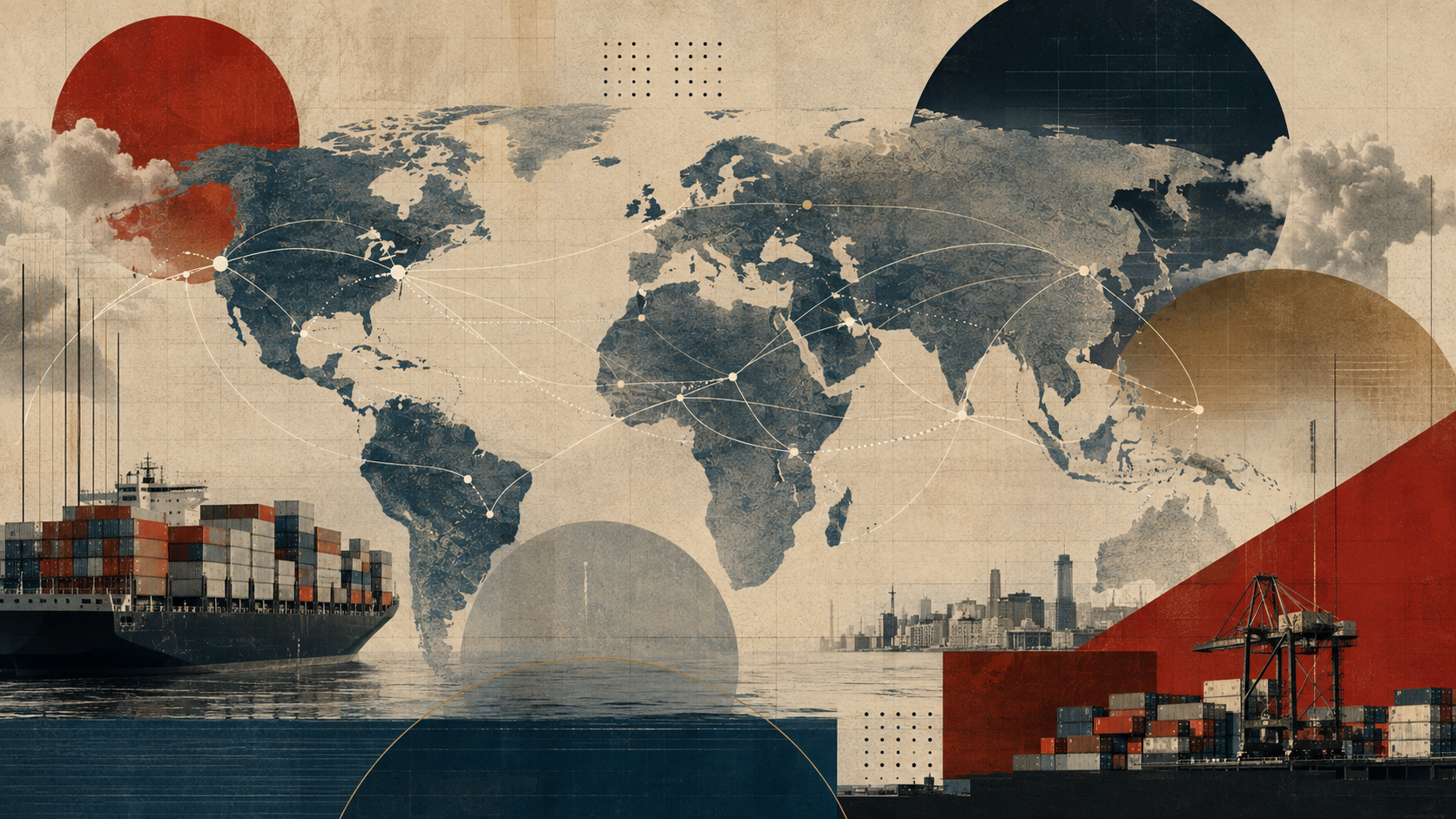
The map is useful again. It shows us where the risks are, certainly. More interestingly, it shows us where connections have become fragile and where new ones might be worth building.
Nicole Junkermann is an international entrepreneur and investor and the founder of NJF Holdings. Through NJF Capital and the wider NJF Holdings investment platform, she has invested in technology businesses across artificial intelligence, cybersecurity, healthtech and other areas of emerging technology. Her Human Code framework explores how technological progress can strengthen human capability, resilience and agency.