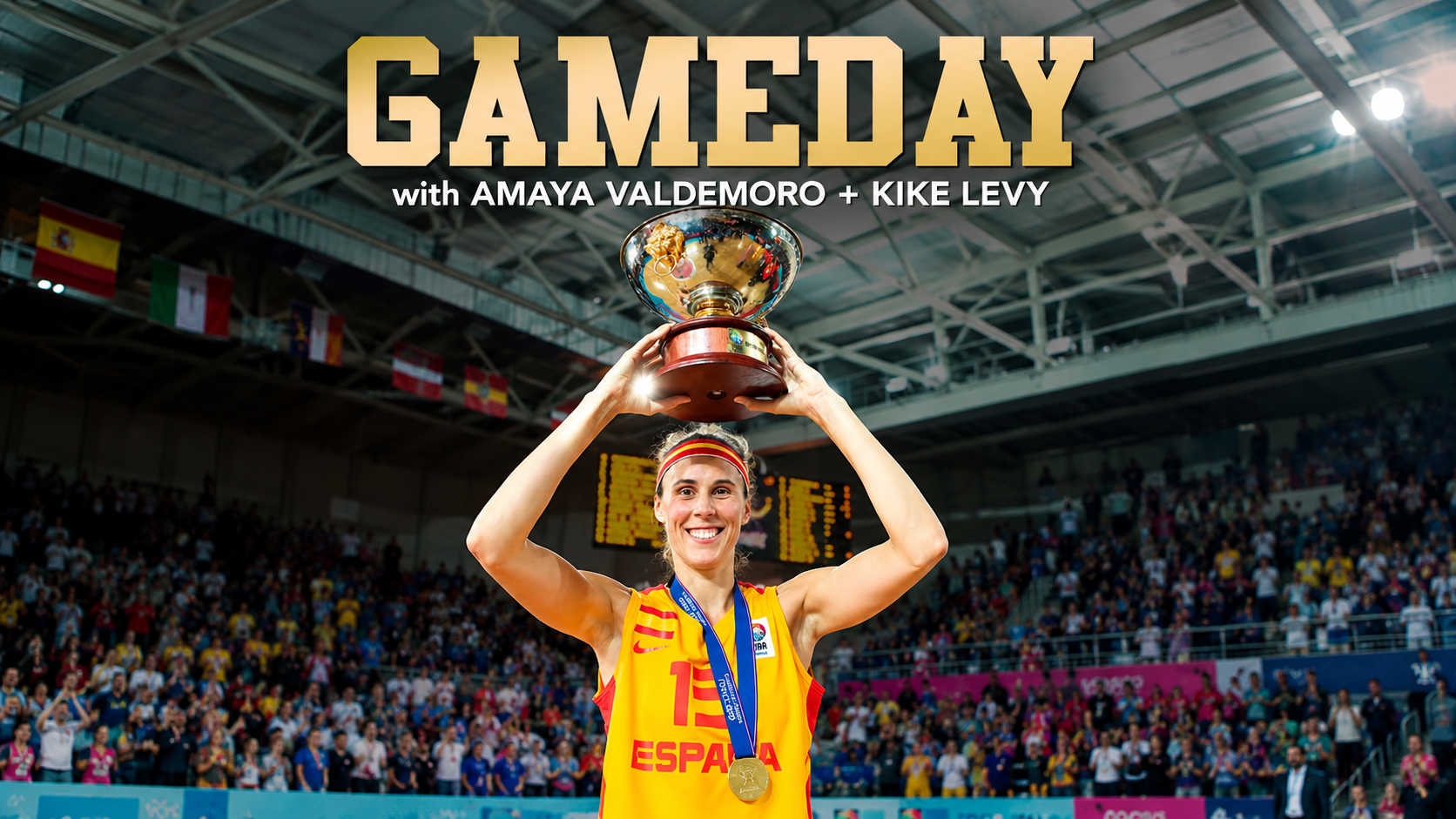
Women’s basketball has changed almost beyond recognition during Amaya Valdemoro’s career. Few people are better placed to explain what happened, or what might come next.
In the latest Gameday Podcast, Valdemoro joins host Kike Levy for a wide-ranging conversation spanning her arrival in the WNBA in 1998, the rise of Caitlin Clark, Spain’s remarkable production line of basketball talent and the new economics transforming women’s sport.
For Valdemoro, the contrast is personal. She was selected 30th in the 1998 WNBA Draft by the Houston Comets and went on to win three consecutive championships with the team. She recalls earning around $30,000 as a WNBA player. A player entering the league in an equivalent position today, she argues, could earn many times that amount.
But money is only one part of the change.
Watch the full Gameday Podcast with Amaya Valdemoro on YouTube.
One of the central themes of the conversation is the commercial opportunity now emerging around women’s sport.
Levy discusses Gameday’s investment in Italian women’s volleyball and argues that women’s sport has characteristics that make it particularly interesting for investors. Athletes have traditionally had to build careers without the financial rewards, media attention and commercial infrastructure available in established men’s competitions. That has helped create unusually close relationships between players and their audiences.
Valdemoro sees the same opportunity.
She remembers an era when women’s basketball in Spain attracted little attention outside players’ families and friends. There were few commercial opportunities and limited media coverage. Even when she became a professional player, facilities, travel and support lagged far behind those available to men.
Today, that gap is narrowing.
The growth of the WNBA is the most visible example, but the broader shift extends across women’s basketball and women’s sport. Better production, stronger distribution, sponsorship, social media and direct relationships between athletes and fans are changing the commercial potential of competitions that were historically underdeveloped.
As Valdemoro puts it, the product itself matters. Better lighting, better arenas, stronger presentation and more investment in the spectator experience can change how audiences perceive a competition.
Perhaps the best illustration of how much sport has changed is the unlikely story of how Valdemoro reached America.
She was discovered almost accidentally.
An American teammate playing in Europe had sent VHS tapes of herself to contacts in the United States. Valdemoro happened to appear in the footage. Her performances caught the attention of the Houston Comets, who subsequently selected her in the 1998 WNBA Draft.
Listen to Valdemoro tell the story on the Gameday Podcast.
The contrast with today’s sporting world is enormous. Highlights can now reach millions of people within hours. Athletes can build audiences independently of their clubs, leagues or broadcasters. Scouts, sponsors and fans can discover talent from almost anywhere.
Valdemoro identifies the arrival of the internet as an early turning point for women’s sport because it created new ways for athletes and competitions to reach audiences.
Social media has accelerated that shift again.
The conversation also touches on a change extending far beyond basketball: fans increasingly follow individual athletes as well as teams and leagues.
That matters commercially.
Valdemoro encourages today’s players to build their own profiles, tell their stories, accept interviews and use the opportunities provided by digital platforms. For athletes who previously depended almost entirely on traditional media for exposure, the smartphone has become a distribution channel of its own.
This is particularly important for women’s sport. Rather than waiting for women’s competitions to reproduce the commercial development of men’s sport over several decades, athletes and leagues can use new platforms to grow differently and more quickly.
“You have to do things differently,” Levy argues during the conversation. Following exactly the same model as established men’s sport means beginning with decades of disadvantage.
Valdemoro agrees. The tools now exist to reach audiences directly.
Few athletes demonstrate the potential of that new model better than Caitlin Clark.
Valdemoro describes Clark’s impact on women’s basketball as extraordinary, pointing to her ability to attract audiences beyond the traditional basketball fanbase. Her distinctive style of play, long-range shooting and digital reach have helped turn individual moments into globally shared content.
For Valdemoro, the significance extends beyond one player. Clark has brought people into women’s basketball who previously had little interest in the sport.
The result is a virtuous circle: greater attention creates greater commercial value, which can support better salaries, production, facilities and competition.
Watch the discussion about Caitlin Clark and the WNBA.
Those changes are beginning to reshape the economics of a professional basketball career.
Valdemoro discusses the WNBA alongside new opportunities including Project B, Unrivaled and the growing financial power of NCAA basketball. Players now have more choices over where they compete, how they earn and how they build their commercial identities.
That creates opportunities for athletes, but it also creates a challenge for European basketball.
Valdemoro believes European leagues will have to compete harder for talent as players gain access to better-paid alternatives in the United States and elsewhere. The answer, she argues, requires investment in the product and a better understanding of what modern audiences want to watch.
Europe has talent. The challenge is turning that talent into a product capable of competing for attention.
Spain provides an interesting case study.
Valdemoro attributes part of the country’s success to a competitive system that exposes players to meaningful competition from an early age. Spanish players learn how to perform when games matter, how to respond to losing and how to make decisions under pressure.
That competitive culture continues to produce results.
The conversation looks at the new generation of Spanish women’s basketball talent, including Awa Fam, Iyana Martín and Marta Suárez, and what their emergence says about the strength of the Spanish system.
But Valdemoro argues that producing great players is no longer enough. Spain also needs to become better at building those players into recognisable personalities and commercial brands.
Investment, representation and visibility all matter.
Running through the episode is a bigger question about how sport survives the transition from an offline culture to an online one.
Valdemoro and Levy belong to a generation that experienced both. They remember sport before smartphones, social media and instant highlights, but now work in an industry where those technologies shape how younger audiences discover athletes and competitions.
The challenge is to adapt without losing what made sport valuable in the first place.
That could mean shorter formats, different production, more accessible commentary, stronger athlete storytelling and content designed for the platforms audiences actually use.
For Gameday, it is also part of a broader thesis about the future of sports media: sporting excellence remains fundamental, but the way that excellence reaches an audience is changing rapidly.
The opportunity in women’s sport comes partly from the fact that much of this infrastructure is being built now.
Valdemoro experienced the old model first-hand. She also helped change it. Her conversation with Kike Levy offers a fascinating view of how far women’s basketball has travelled and why its biggest commercial transformation may still be ahead.
Watch the full Amaya Valdemoro episode of the Gameday Podcast.
Watch more episodes from Gameday Podcast Season 3, or follow Gameday on Instagram, TikTok, Spotify, LinkedIn and Apple Podcasts.
Gameday Podcast is powered by NJF Holdings, founded by Nicole Junkermann.