By Nicole Junkermann, founder of NJF Holdings
We tend to imagine the digital economy as something weightless. Information appears on our screens almost instantly, financial transactions cross borders in seconds and companies can serve customers thousands of miles away without most people giving much thought to the physical journey involved.
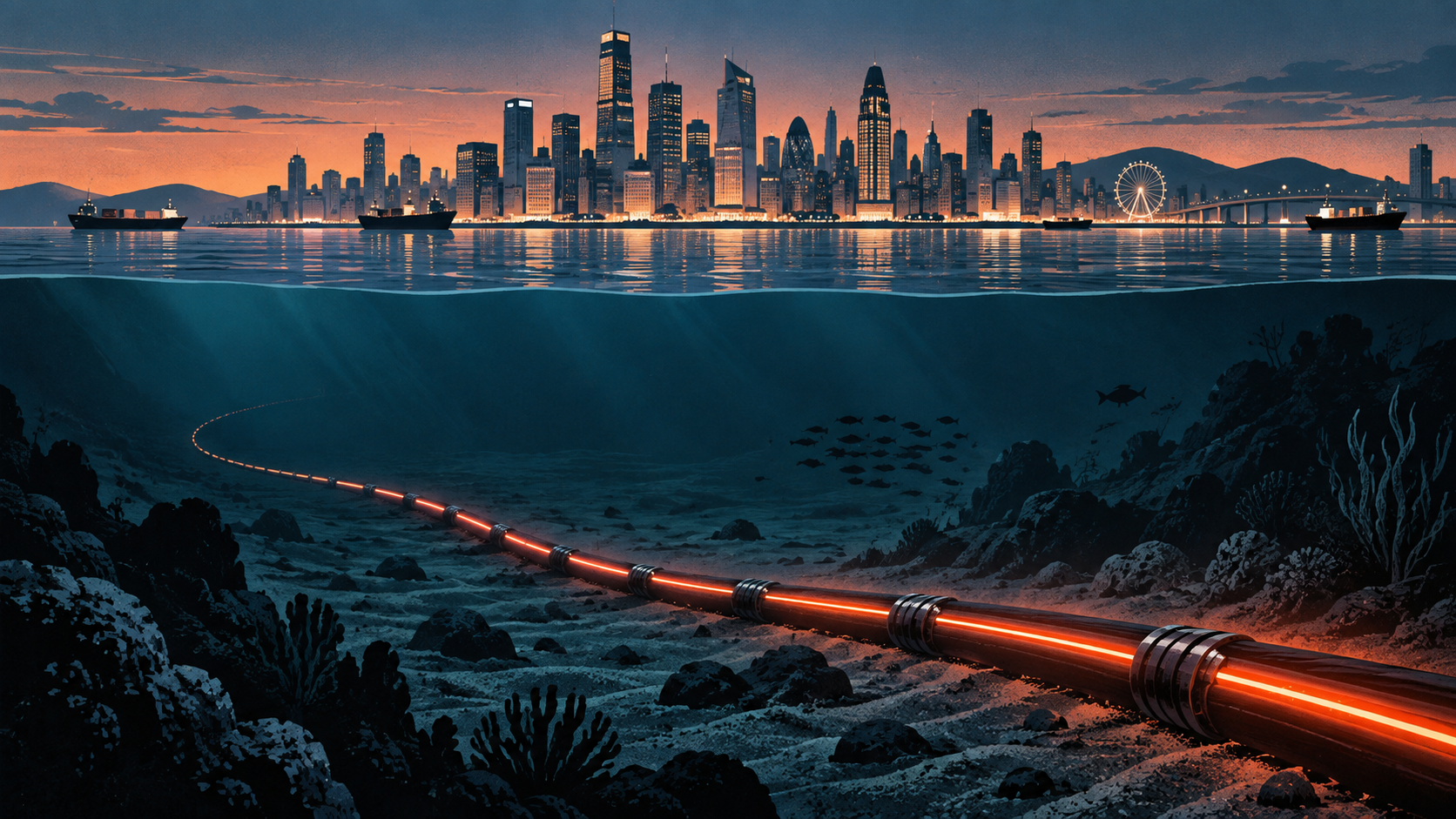
But the digital world rests on distinctly physical foundations. Undersea cables, satellites, data centres, electricity grids and landing stations carry and process the information on which modern economies increasingly depend.
The International Telecommunication Union estimates that submarine cables carry more than 99 per cent of international data traffic. These networks enable financial transactions, government communications, cloud computing, public services and much of the ordinary digital activity people now take for granted.
Despite their importance, they remain largely invisible outside the specialist industries responsible for building and maintaining them. Public attention generally arrives only when a cable is damaged, a service is interrupted or an isolated failure exposes a much wider dependency.
Discussion about technology tends to focus on the systems people can see and use. We talk about smartphones, software, digital platforms and the services changing how businesses operate, while paying considerably less attention to the infrastructure that makes them possible.
Every apparently seamless digital service depends on a complex chain of physical assets. Data must travel through cables, arrive at secure facilities, receive sufficient energy and pass through networks capable of handling continually rising demand.
The scale of this system is considerable. The ITU says the global network includes more than 500 operational submarine cable systems covering around 1.4 million kilometres, while international bandwidth demand has grown rapidly in recent years.
That growth reflects a deeper economic change. Connectivity is no longer simply a supporting utility for the technology sector, because it has become an essential input for almost every industry.
Healthcare providers need secure access to patient information and research data. Manufacturers depend on connected supply chains, financial institutions process enormous volumes of transactions, and media companies distribute content to audiences across multiple markets.
When the infrastructure connecting these activities works properly, it disappears into the background. Its reliability can therefore create the illusion that availability is automatic, even though maintaining it requires continuing investment, technical expertise and international cooperation.
The risks facing undersea infrastructure shouldn’t be exaggerated. Between 150 and 200 cable faults are reported globally during an average year, with fishing activity, ship anchors, geological events and ordinary equipment failures accounting for many of them.
That context matters because resilience isn’t solely a response to exceptional crises. It’s the everyday capacity to absorb disruption, redirect activity and restore services before a local failure becomes a wider economic problem.
A resilient system doesn’t assume that every fault can be prevented. Instead, it recognises that failures will occur and ensures that sufficient alternatives, repair capacity and operational knowledge are available when they do.
This distinction should shape how businesses and governments approach infrastructure planning. The objective isn’t to eliminate every possible risk, which would be impossible, but to prevent a predictable interruption from producing disproportionate consequences.
For several decades, organisations have designed systems primarily around efficiency. Supply chains became leaner, spare capacity was reduced and essential services were often concentrated among a relatively small number of highly capable providers.
That model lowered costs and supported remarkable growth. But it also produced dependencies that can become vulnerabilities when demand surges, equipment fails or access to a critical connection is interrupted.
A system can be commercially efficient while remaining operationally fragile. If a single cable, supplier, data centre or energy connection becomes too important to lose, the lack of credible alternatives is no longer merely a technical concern.
The answer isn’t to abandon international markets or attempt to reproduce every capability within national borders. Genuine resilience comes from identifying where concentration has become dangerous, developing alternative routes and ensuring that disruption in one part of a network doesn’t disable the whole system.
Redundancy can look inefficient under normal conditions because it involves maintaining capacity that may not be used every day. Its economic value becomes clearer during disruption, precisely when it’s too late to begin building it.
Europe has started to give this infrastructure greater attention. The European Commission has introduced measures intended to improve submarine cable security and resilience, including funding for new and upgraded connections, repair capability and better coordination between national authorities.
This direction is welcome because digital ambitions need physical foundations. Europe can’t expand its technology economy, modernise public services or strengthen its position in strategically important industries without investing in the infrastructure those ambitions require.
The private sector has an equally important role. Infrastructure operators, telecommunications companies, technology businesses, investors and insurers each possess different information about how networks operate and where their vulnerabilities may lie.
Those groups need to cooperate before failures occur rather than meeting for the first time during a disruption. Shared planning, realistic stress testing and clearly assigned responsibilities can substantially reduce the economic impact of an incident.
At NJF Holdings, we look at technology in the context of the wider systems it depends upon and the markets it can enable over time. That perspective increasingly requires investors to consider resilience alongside growth, efficiency and financial return.
Infrastructure has traditionally been evaluated through measures such as demand, reliability, yield and the predictability of cash flows. Those remain important, but concentration risk, repair capacity and strategic relevance deserve greater weight in a world that depends so heavily on uninterrupted connectivity.
Modern economies have become exceptionally good at hiding their complexity from users. A payment, message or video call can cross continents without revealing the cables, facilities, energy and human expertise that make the journey possible.
That simplicity is one of technology’s greatest achievements. But it shouldn’t prevent governments, businesses and investors from recognising the scale of the physical system underneath it.
Resilient infrastructure isn’t built through alarmism or isolation. It comes from patient investment, diversified capacity, practical cooperation and an honest assessment of the connections on which economies have become dependent.
The technologies people notice least are often the ones modern life relies upon most. Protecting and strengthening them is therefore not a peripheral technology issue, but a central economic responsibility.
Nicole Junkermann is an international entrepreneur and investor and the founder of NJF Holdings. Through NJF Capital and the wider NJF Holdings investment platform, she has invested in technology businesses across artificial intelligence, cybersecurity, healthtech and other areas of emerging technology. Her Human Code framework explores how technological progress can strengthen human capability, resilience and agency.