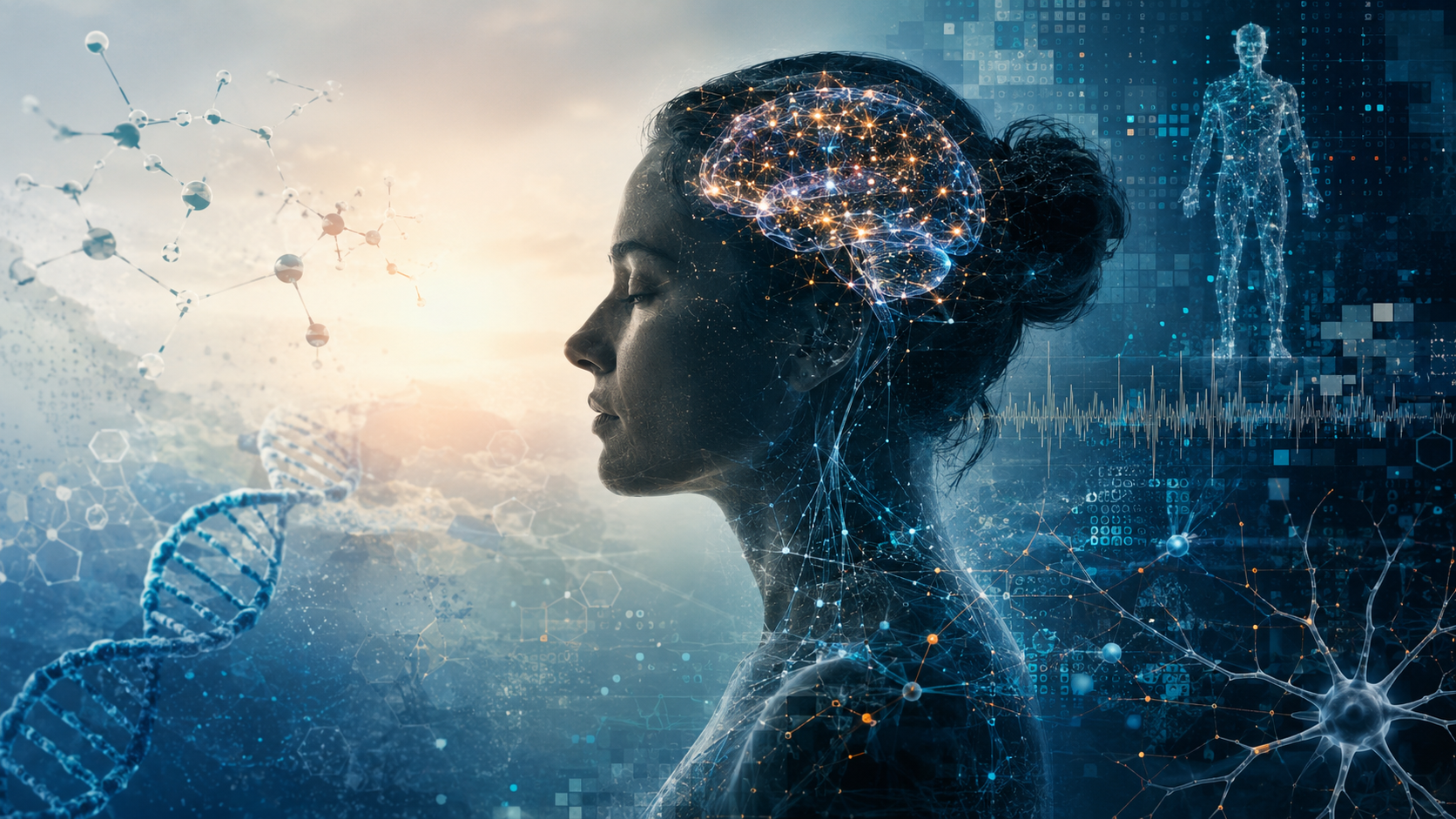
Nicole Junkermann examines how AI and life sciences are reshaping medicine, neuroscience and the future of human identity.
Nicole Junkermann examines how AI and life sciences are reshaping medicine, neuroscience and the future of human identity.
By Nicole Junkermann, Founder of NJF Holdings
For centuries, progress was measured by how far humanity could reach beyond itself. From the Age of Discovery to the space race, expansion meant escape – the conviction that entirely new worlds lay out there, waiting. But the most consequential frontier of this century doesn’t require a rocket. It lies within.
AI and the life sciences are converging to create a new cartography of the human being. Machine-learning models can already predict disease years before symptoms appear, design novel molecules in hours, and read the flickering patterns of brain activity with a precision that would have seemed implausible a decade ago. The tools we once built to map galaxies are being turned inward.
The shift this enables is simple, if staggering. Medicine is moving from reaction to prediction – from fixing what’s broken to preventing it from breaking. But that shift will depend less on raw computing power than on how intelligently we can share what we already know.
Owkin, in which NJF was an early investor, shows how collaboration can be as transformative as computation. Its federated-learning model lets hospitals and laboratories work together without ever moving patient data. Algorithms travel to the data, learn from it locally, and return anonymised insights that strengthen the network as a whole. Knowledge without surrender. Progress without extraction. Applied at scale, this kind of decentralised learning could form the backbone of a healthcare infrastructure built on trust rather than on the accumulation of data as an end in itself.
That matters because the alternative is already visible. When data aggregation becomes the goal rather than the means, discoveries get captured rather than shared. The federated model is a structural answer to that problem, not merely an ethical preference.
Beyond biology lies the mind – perhaps the last territory genuinely resistant to mapping. Neuroscience and computation are beginning to produce what you might call a mirror world of human cognition: digital approximations of how we think, feel, and remember. Brain-computer interfaces are already restoring movement to paralysed patients and speech to those who’ve lost their voices. These are not prototypes. They are clinical realities.
But as the line between thought and technology blurs, a new ethical terrain emerges. The brain, once the final sanctuary of privacy, is becoming partially transparent to machines. What happens when data can reveal intention before action? When emotional state can be quantified and sold? The same tools that restore speech could, in different hands, be used to read it before it’s spoken.
As we map biology and cognition, the temptation grows to treat the self as raw material. The genome and the connectome – the full wiring diagrams of body and brain – risk becoming commodities. If the 20th century was defined by the extraction of natural resources, the 21st may be defined by the extraction of human ones.
Who controls that data will determine who benefits from the next revolution in science. Without structural guardrails, ownership of our most intimate information will drift from individuals to institutions. That’s not a hypothetical risk. It’s already the direction of travel in markets where data regulation has lagged behind data capability.
Investors stand at the moral faultline of this transformation. Capital has always shaped which discoveries flourish and which values they encode. That isn’t a responsibility that can be outsourced to regulation after the fact.
The case for backing companies like Owkin isn’t simply ethical. Federated architectures are more durable precisely because they don’t accumulate the systemic risks that come with centralised data lakes: regulatory exposure, single points of failure, the slow erosion of institutional trust. Science that shares rather than hoards knowledge tends, over time, to produce better science. That’s an investment thesis, not just a values statement.
The most valuable life sciences companies of the next decade won’t just be the ones that can cure disease. They’ll be the ones that can do it while keeping the patient, rather than the platform, at the centre of the transaction.
The deeper scientists probe, the more one mystery persists: consciousness itself. Even as algorithms mimic perception and reasoning with increasing fidelity, they can’t replicate awareness – the quality that gives thought its meaning rather than just its structure. That gap may narrow. It may not. But the exploration of inner space keeps returning us to it.
AI can model the architecture of the mind. What it can’t explain is why that architecture produces the experience of being alive – the part that makes the data worth having in the first place.
The quest to understand ourselves is the most ambitious journey yet undertaken – measured not in miles but in molecules and memories. It demands the same courage that once sent rockets into orbit, and it will require a clearer set of ethical commitments than the digital revolution managed to articulate before the damage was done.
The frontier is real. So is the risk that we map it in service of extraction rather than understanding. The question isn’t whether to explore. It’s who gets to own the map.
About Nicole Junkermann
Nicole Junkermann is an international investor focused on technology, sports and media. She leads NJF Holdings, a global investment group, and its sports platform Gameday by NJF Holdings, which invests in sports leagues, media rights and technology-driven fan engagement. Her work in the sector focuses on building long-term sports infrastructure and expanding the commercial and global reach of professional leagues.