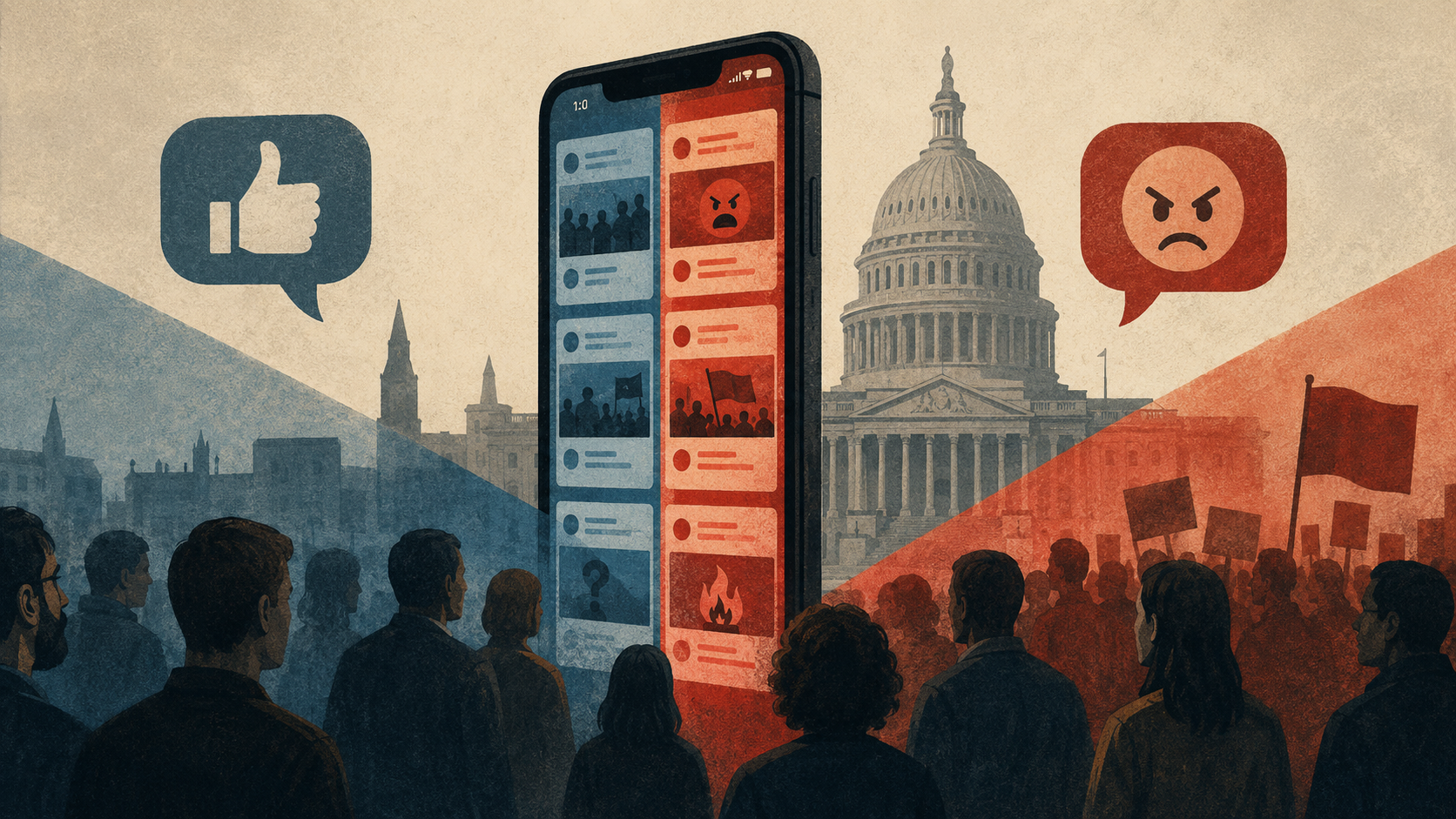
The most dangerous thing AI is doing to democracy isn’t making deepfakes. It’s making disagreement feel like war.
Trust in governments, media organisations and public institutions has been declining across much of the developed world for years. At the same time, artificial intelligence is dramatically increasing the speed, scale and sophistication of information flows. These trends are often discussed separately. Increasingly, they are becoming the same problem.
Much of the debate around AI and democracy focuses on fabricated images, synthetic videos and automated propaganda. Those risks are real. But they are not the deepest challenge.
The larger threat is the gradual erosion of the shared informational foundations that democratic societies depend upon. Democracies do not require everyone to agree. They require people to operate from a broadly shared understanding of reality. As AI accelerates the production and distribution of information, that foundation is becoming harder to maintain.
This is not simply a content problem. It is an incentive problem.
Artificial intelligence has made the creation of content cheaper, faster and more scalable than ever before. But the greater issue lies in the systems that determine what people see.
Algorithms optimised for engagement don’t reward nuance. They reward outrage, certainty and tribal affiliation. Content that provokes anger or reinforces existing beliefs consistently outperforms content that encourages reflection or complexity.
Research across multiple platforms has pointed to similar dynamics. Internal studies conducted by major tech companies have repeatedly shown that recommendation systems can intensify polarisation by steering users towards increasingly extreme content. The result is not simply more misinformation. It is a structural shift in how people relate to truth, uncertainty and those who hold opposing views.
This dynamic is visible across political movements, ideological communities and cultural debates. The issue isn’t confined to any single party, country or demographic group. The architecture itself incentivises division.
The consequences are increasingly measurable. The World Economic Forum now ranks misinformation and disinformation among the most significant global risks facing societies. Trust in traditional news sources continues to decline in many countries. At the same time, conspiracy theories and identity-based hostility are becoming more deeply embedded in public discourse.
Rising antisemitism across Europe and North America is one warning sign among many. History shows that when conspiracy theories, dehumanisation and scapegoating become normalised against any group, democratic cohesion begins to weaken. What is different today is the speed, scale and sophistication of the technologies amplifying those dynamics.
Governments are beginning to respond.
Europe has taken the lead in constructing a regulatory framework. The EU AI Act, which comes fully into force in August 2026, introduces transparency requirements for AI-generated content and obliges major platforms to assess systemic risks. The European Democracy Shield adds a dedicated focus on democratic resilience and information security.
These are important developments. They recognise that AI governance is not solely about frontier models and technical safety. It is also about the health of the public information environment.
But the gap between regulation and reality remains substantial.
Enforcement timelines stretch years into the future. Platforms continue to evolve faster than regulators can adapt. Meanwhile, geopolitical tensions are making international coordination more difficult. The United States has already criticised elements of Europe’s digital regulatory framework as potential trade barriers, highlighting the growing intersection between technology governance and geopolitical competition.
The platforms themselves continue to face conflicting incentives. Measures that reduce engagement often reduce revenue. Voluntary commitments tend to remain in place only until they become commercially inconvenient.
This is why legislation alone will not be enough.
Tech alone won’t be able to solve a problem that tech helped create.
The answer isn’t a single law, regulator or platform policy. It is a broader civic compact that aligns incentives across institutions.
That compact would require governments, universities, technology companies, civil society organisations and ethical communities to recognise that the health of the information environment is a shared responsibility.
Several practical elements are already visible.
Greater investment in interdisciplinary research examining AI-driven manipulation and online radicalisation. Shared international standards for synthetic media transparency and provenance. Public education initiatives focused on critical thinking and media literacy. Cross-community dialogue programmes designed to build resilience against polarisation rather than simply react to it.
None of these measures eliminate disagreement.
Nor should they.
Disagreement is an essential feature of democratic life. The objective is not consensus. The objective is preserving the conditions that make meaningful disagreement possible.
A functioning democracy requires citizens to accept complexity, tolerate uncertainty and engage with those who see the world differently. Those capacities are becoming increasingly fragile.
Throughout my career as an investor, I have been most interested in infrastructure.
Not the visible applications that capture headlines, but the underlying systems that shape how societies function.
Much of today’s AI governance debate focuses on frontier technologies. Questions about capability, safety, alignment and control deserve attention. They will shape the trajectory of the technology for decades.
But while policymakers debate the future of advanced AI systems, something less visible is already happening.
The machinery of algorithmic amplification is quietly reshaping how democratic societies relate to truth.
What concerns me most is not the dramatic scenario in which democracy suddenly fails. It is the slower process through which trust gradually weakens, institutions lose legitimacy, and citizens become less willing to grant good faith to those who disagree with them.
Trust, tolerance and democratic norms take generations to build.
Artificial intelligence, operating through the incentive structures currently in place, can erode them far more quickly.
The institutions capable of responding already exist. Governments, universities, technology companies, civil society organisations and international bodies all have a role to play.
The question is whether they can coordinate quickly enough.
This isn’t a rhetorical concern. It’s a timing problem.
Democratic societies spent decades building the trust and shared norms that make political life possible. AI is testing those foundations at unprecedented speed. The challenge now is ensuring that governance, institutions and civic culture can evolve before the erosion becomes self-reinforcing.
Because once trust becomes the casualty of technological progress, rebuilding it is far harder than protecting it in the first place.
This challenge sits at the heart of what I call The Human Code.
Technology is not inherently democratic or anti-democratic. It reflects the incentives, values and priorities of the systems that build and govern it. The question is not whether artificial intelligence will continue to become more powerful. It will. The question is whether the institutions surrounding it can evolve quickly enough to ensure that human judgement, human dignity and social trust remain at the centre of decision-making.
Throughout history, societies have been shaped by the infrastructure they create. Roads shaped empires. Printing presses shaped nations. The internet reshaped the global economy.
Artificial intelligence is becoming the next layer of infrastructure.
If we focus only on what AI can do, we risk missing the more important question: what kind of society is it helping us build?
The future will not be determined by technology alone. It will be determined by the values embedded within it, the incentives that govern it and the choices we make about how it serves people.
That is why AI governance is not simply a regulatory challenge. It is a human one.
About Nicole Junkermann
Nicole Junkermann is an international investor focused on technology, sports and media. She leads NJF Holdings, a global investment group, and its sports platform Gameday by NJF Holdings, which invests in sports leagues, media rights and technology-driven fan engagement. Her work in the sector focuses on building long-term sports infrastructure and expanding the commercial and global reach of professional leagues.