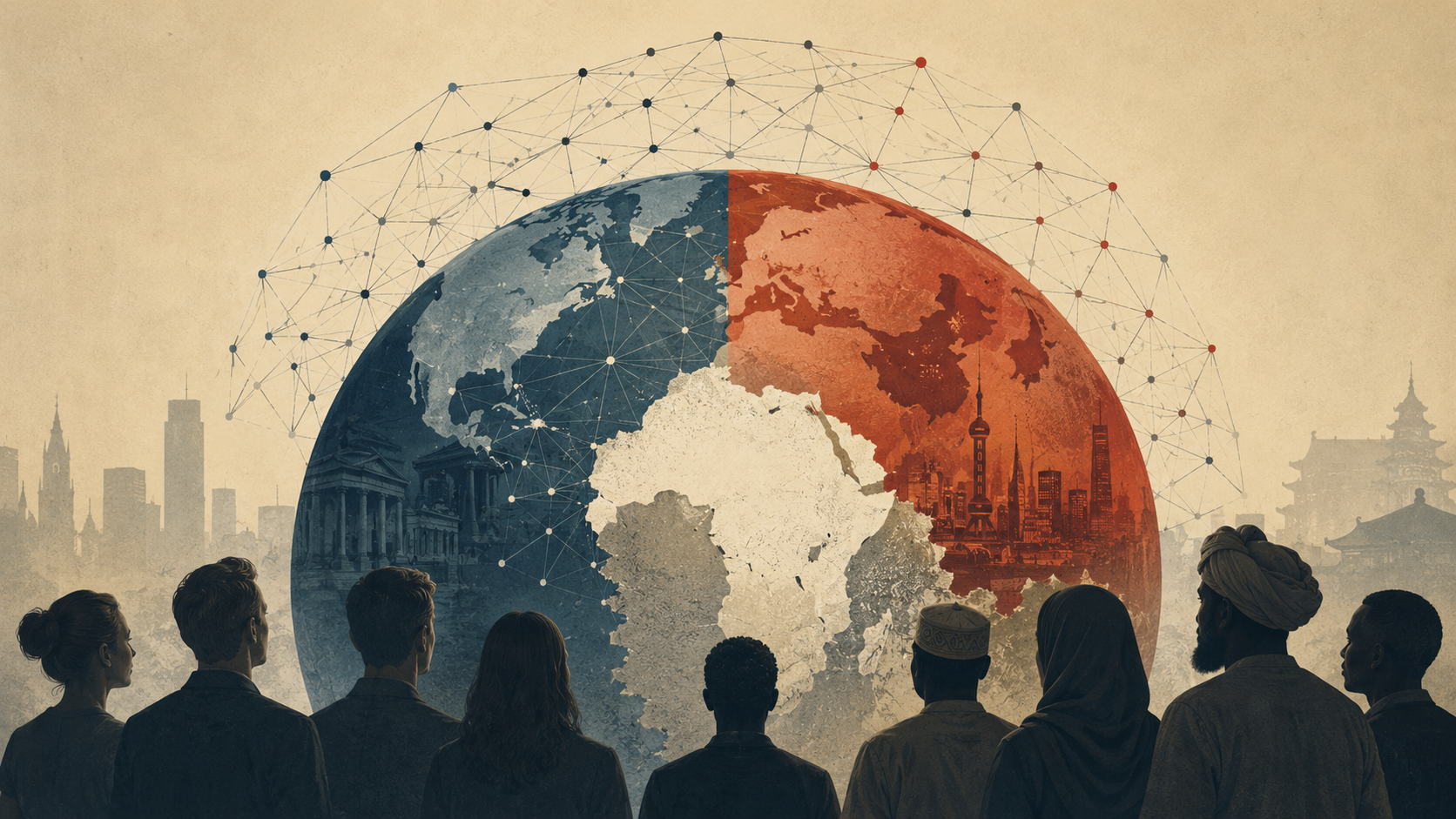
The Economist recently did something clever: it put 25 frontier AI models through the World Values Survey, the long-running poll that has mapped human beliefs across more than 100 countries since 1981. The headline finding was that models built in the West lean secular and liberal, while those built in China carry the imprint of state censorship. Most of the commentary has focused on that contrast. I think the more consequential finding sits quietly in the middle of the piece: not a single model tested reflects the worldview of most African or Muslim countries.
Consider what that means in practice. Close to a billion people now use generative AI, and a growing share of them consult it not for facts but for judgement – how to handle a family conflict, how to raise a child, how to weigh a decision with moral stakes. For hundreds of millions of those users, every answer arrives filtered through assumptions formed somewhere else. The model speaks their language. It doesn’t speak their life.
It’s tempting to read this as a story about bias, and to argue about whose values are correct. I find that framing sterile. The more useful lens is the one investors apply to any market: where is demand not being met, and why?
The demand is demonstrably there. The article describes Ansari, an Islamic chatbot built by a former Google and Uber engineer, which thousands of Muslims already use for questions of faith and daily decisions. That’s what an early signal looks like: a technically sophisticated builder, an underserved population, and users arriving without being marketed to. When people go to the trouble of building their own alternative to some of the best-funded products in history, they’re telling you something about the incumbents.
The supply-side failure is structural, which is why it persists. Models absorb their values from training data, and the internet’s text skews heavily towards a handful of languages and cultures. Post-training then aligns models to the sensibilities of the labs that build them, concentrated in San Francisco and Hangzhou. Nobody decided to exclude the worldviews of Lagos, Jakarta or Doha. The pipeline simply wasn’t built to include them – and pipelines don’t correct themselves.
Markets abhor a vacuum, and this one is already being filled – by default rather than design. Chinese models, cheaper to run and freely modifiable, are gaining ground across the developing world. Cost-conscious users will take fast and inexpensive over culturally fluent, if that’s the choice on offer.
But it needn’t be the choice on offer. The interesting opportunity is AI that’s genuinely grounded in the regions it serves: trained with local language depth rather than thin translation, aligned with local institutions rather than distant ones, and – critically – built with local ownership rather than merely local distribution. The Gulf is instructive here. Sovereign investors aren’t just buying compute; they’re funding Arabic-first models precisely because they understand that linguistic and cultural infrastructure is still infrastructure. What’s true of ports and grids is becoming true of models: the countries and communities that own theirs will depend less on the values of others.
The distinction between serving a market and extracting from one matters enormously here. The history of technology in developing markets is full of products localised at the interface and foreign at the core. Translation is not representation. The ventures that win this market durably will be the ones where the communities served hold real equity, real editorial authority over alignment, and real technical capacity – not a translated veneer over someone else’s assumptions.
The Human Code is the framework I use to assess emerging technologies. It asks three simple questions: who benefits, what endures, and what might break if this succeeds too well? Applied here, they cut both ways. AI that ignores most of the world’s worldviews fails the first test. But AI fragmented into a thousand sealed value-systems, each confirming its users and conversing with no one, would fail the third. The aim isn’t a different echo for every chamber; it’s plurality with bridges – models that represent their communities faithfully while remaining transparent about what they are and interoperable with everything else.
That balance won’t emerge on its own. It will be built, or it won’t – and it will be built by whoever shows up with patient capital and genuine respect for the markets involved. The worldviews AI forgot aren’t a footnote to this technology’s story. They’re several billion people, and the next great test of The Human Code: whether innovation can create lasting value while strengthening the societies it serves.
Read the full story here: https://www.economist.com/briefing/2026/06/25/ai-models-values-are-very-different-from-most-peoples
Nicole Junkermann is an international investor focused on technology, sports and media. She leads NJF Holdings, a global investment group, and its sports platform Gameday by NJF Holdings, which invests in sports leagues, media rights and technology-driven fan engagement. Her work in the sector focuses on building long-term sports infrastructure and expanding the commercial and global reach of professional leagues.