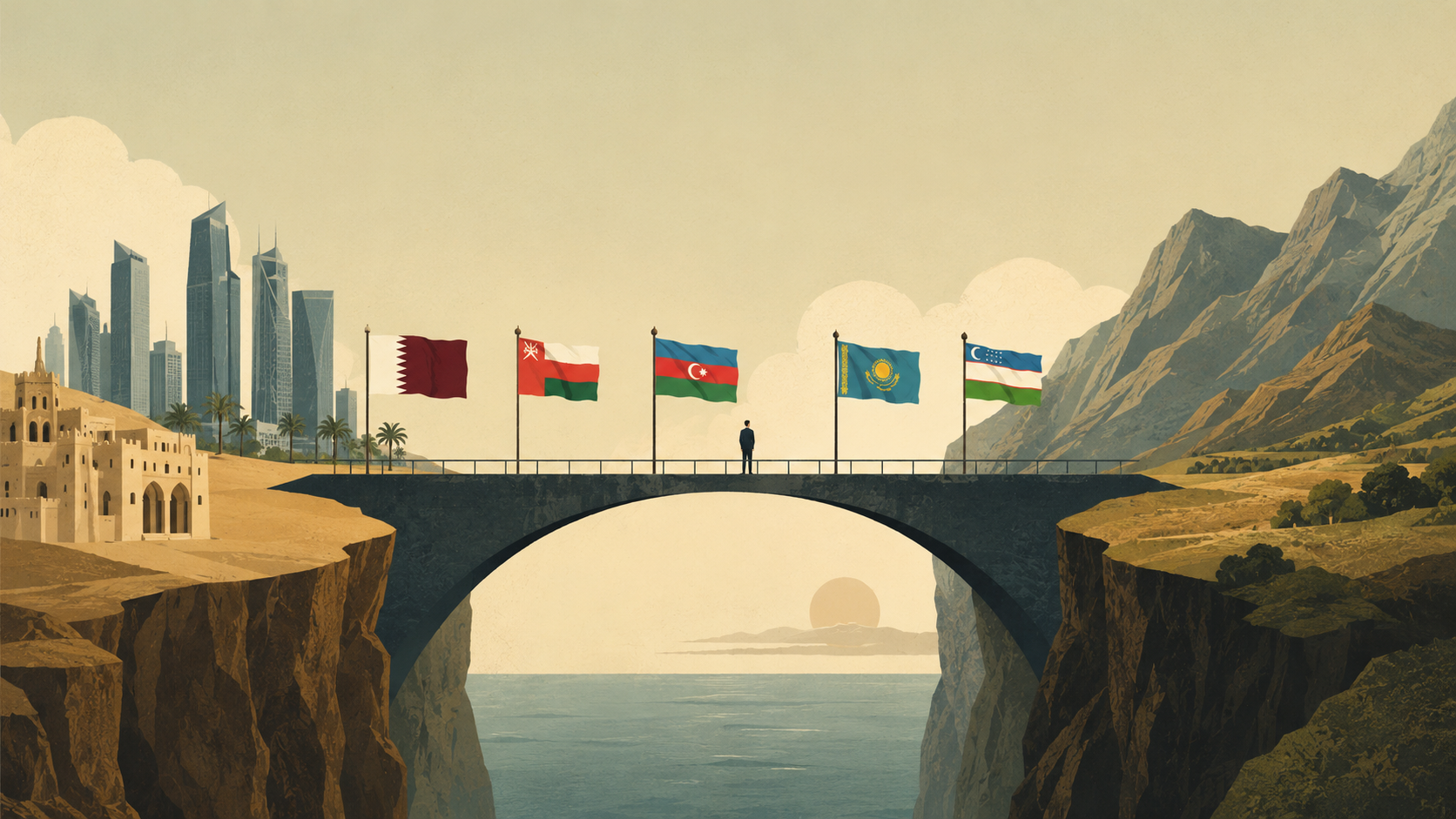
In response to Zaur Shiriyev, “Don’t dismiss the mini-middle powers”, Financial Times, 16 August 2026
Zaur Shiriyev makes an interesting distinction in the Financial Times between the middle powers we hear a great deal about and a smaller group of countries whose influence is more concentrated. He calls them the “mini-middle powers”: states that cannot set the international agenda but have enough leverage in particular areas to affect what happens.
His examples are well chosen. Qatar and Oman have diplomatic access that larger countries sometimes lack. Azerbaijan, Kazakhstan and Uzbekistan benefit from geography, energy, infrastructure and their position along increasingly important trade routes. As Shiriyev argues, the important thing is not simply possessing these advantages. It is knowing how to use them.
I think there is another reason these countries deserve our attention. They are showing us that, as the international system becomes more fragmented, connection itself is becoming a source of geopolitical power.
One of the most interesting observations in Shiriyev’s piece is that Azerbaijan, Kazakhstan and Uzbekistan maintain relationships in several directions because exclusive alignment would be risky. They work with Russia and China, but also Turkey, Europe and the United States. Qatar and Oman have close security relationships with Washington while maintaining channels to governments and organisations Washington itself can struggle to reach.
It would be easy to dismiss this as hedging. Sometimes, of course, that’s exactly what it is. Smaller countries living alongside much larger powers have always needed a degree of pragmatism.
But something more interesting happens when communication between the larger powers starts to break down. The country that can still speak to both sides becomes useful. The trade route that doesn’t depend on one geopolitical bloc becomes more valuable. A government with relationships across a political divide suddenly has options that a more powerful but less connected country doesn’t.
Shiriyev makes this point neatly when he writes that Qatar and Oman’s mediation becomes more valuable when the parties are no longer talking. I think that principle extends well beyond mediation.
Qatar is perhaps the clearest example because its international influence would make little sense if measured by conventional size alone.
Its gas reserves clearly matter. So does its financial strength. But Qatar has also spent years building relationships across countries, institutions and political movements that don’t necessarily have relationships with each other. Shiriyev describes this as turning “gas wealth, finance and access to hard-to-reach actors into an outsized diplomatic role”.
The word access matters.
Diplomatic access isn’t something that can easily be constructed in the middle of a crisis. Trust takes time, particularly between people who disagree profoundly. Maintaining a channel can also be uncomfortable. Governments are sometimes criticised precisely because they continue talking to actors that their allies would rather isolate.
But the usefulness of those relationships becomes clearer when a crisis arrives. If everyone only talks to people with whom they already agree, there isn’t much diplomacy left to do.
Oman has built a similar capability in a quieter way. Its reputation for discretion and its ability to maintain channels between adversaries have made it useful repeatedly. Neither Qatar nor Oman can dictate outcomes to larger powers. Their influence comes from being able to do something those larger powers sometimes cannot do for themselves.
The same logic looks different in Central Asia and the South Caucasus.
Shiriyev points to the Middle Corridor linking Asia and Europe through countries including Kazakhstan and Azerbaijan. It is less straightforward than the northern route through Russia, but that is precisely why its value has risen. Governments and businesses now have another option.
This is an important feature of the emerging geopolitical landscape. Efficiency used to dominate many decisions about trade, energy and supply chains. Resilience now matters far more. The shortest route isn’t necessarily the most valuable if losing it leaves you with nowhere else to go.
That gives countries sitting on alternative routes new leverage. Azerbaijan’s energy becomes more important when buyers want alternatives. Kazakhstan’s oil and uranium matter alongside its position between Russia and China. Uzbekistan’s location and population give it a growing role in the trade and politics of Central Asia.
Shiriyev is careful about the limits of this influence. If relations with Russia improve, for example, some freight may return to northern routes. That’s an important qualification. These countries haven’t escaped geography or the influence of larger neighbours. They have simply become better at using what geography gives them.
There is a broader lesson here that matters well beyond these five countries.
We tend to talk about bridge-building as though it were an expression of goodwill. I think we should start treating it more seriously. In a world where political relationships are becoming harder, the ability to maintain connections across them has practical value.
That applies to governments, but it also applies to universities, investors, companies, cultural institutions and sport. These relationships operate differently from diplomacy, but they can preserve connections between societies when formal political relationships deteriorate. They create places where people still meet, ideas still travel and some degree of trust can survive.
None of this means pretending that differences don’t matter. There are moments when governments have to choose, and there are relationships they shouldn’t preserve at any cost. Bridge-building without principles quickly becomes opportunism.
But the opposite instinct carries risks too. A world divided into increasingly self-contained blocs would be poorer, less innovative and considerably more dangerous. Somebody still has to connect them.
Shiriyev ends with an important qualification. These mini-middle powers will not determine the next international order. Larger countries will continue to possess vastly greater military, economic and technological power. But size and influence aren’t quite the same thing.
The international system taking shape around us is likely to have several centres of power, overlapping alliances and more contested trade routes. Countries will cooperate in one area while competing fiercely in another. In that environment, maintaining relationships in several directions can create room to manoeuvre rather than simply revealing an unwillingness to choose.
Perhaps this is what the rise of the mini-middle powers really tells us. Qatar, Oman, Azerbaijan, Kazakhstan and Uzbekistan have very different histories and interests, but each has found ways to make itself useful beyond what its size might suggest.
For a long time, geopolitical power was associated with the ability to make others move. In a more fragmented world, some of the most interesting countries may be those that can still bring others together.
Nicole Junkermann is an international entrepreneur and investor and the founder of NJF Holdings. Through NJF Capital and the wider NJF Holdings investment platform, she has invested in technology businesses across artificial intelligence, cybersecurity, healthtech and other areas of emerging technology. Her Human Code framework explores how technological progress can strengthen human capability, resilience and agency.