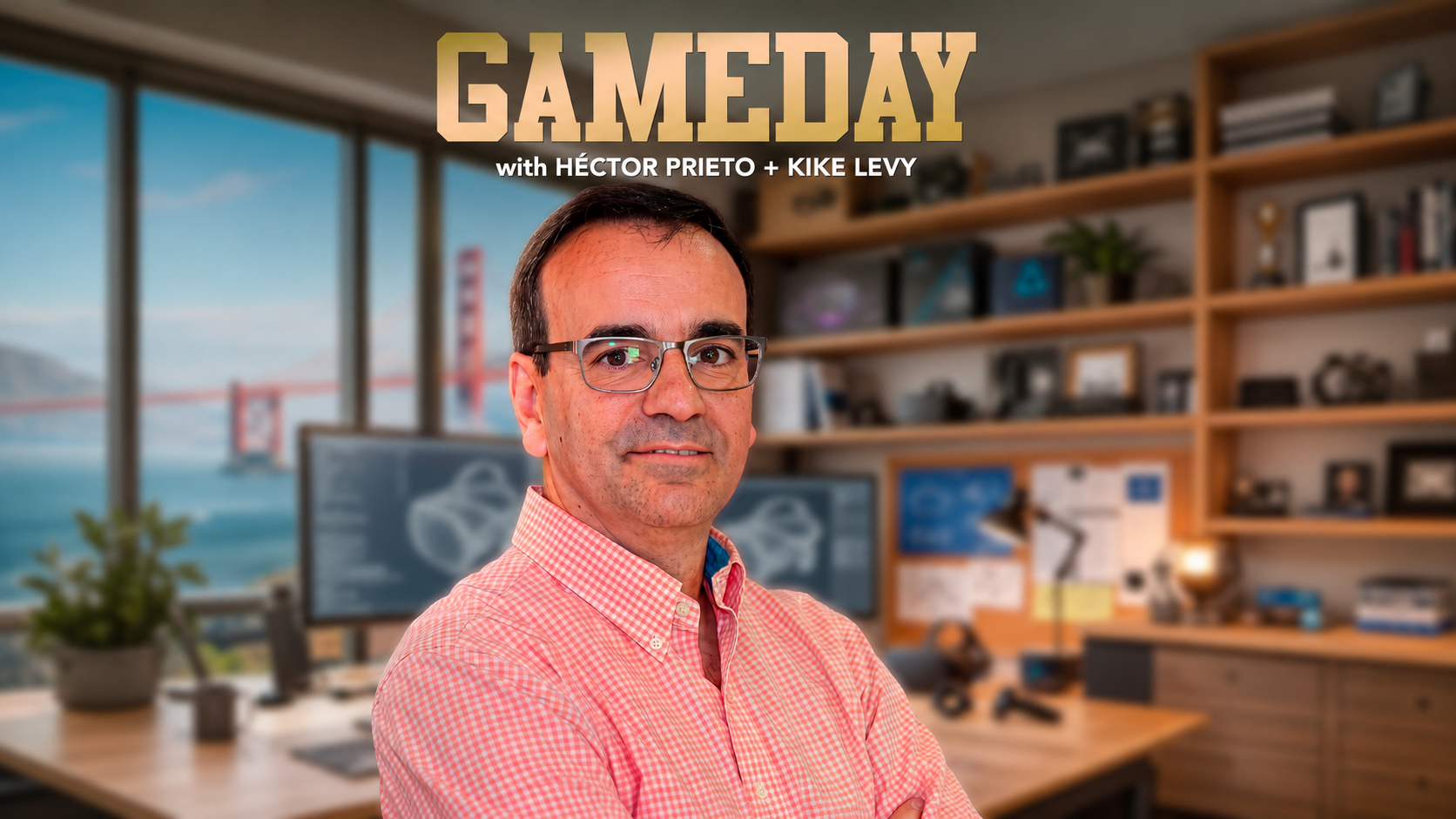
On the latest episode of the Gameday Podcast, from Gameday by NJF Holdings – the sports media company founded by investor Nicole Junkermann – host Kike Levy sits down with the co-founder and CEO of YBVR to talk about virtual reality, the infinite stadium, and the sports rights nobody has valued
Ten years ago, talking about virtual reality in sport was a way to clear a room. Héctor Prieto did it anyway. The engineer sold his first company to Ericsson, moved his family to the United States, and then did the most Silicon Valley thing imaginable: he started again in a garage in San José, on a street called Yerba Buena. The company took its name from the street. YBVR has been streaming immersive sport ever since.
In this episode of the Gameday Podcast, Kike Levy – who watched the first VR wave up close during his years at Meta – gets Prieto to lay out where the technology actually stands, away from both the metaverse hype of 2021 and the obituaries that followed it.
YBVR’s founding insight came straight from telecoms. Bandwidth is scarce, so send the pixels where the eye is looking. The result, Prieto says, was roughly four times the visual quality at half the bandwidth – enough to make live 360-degree sport watchable rather than nauseating. The company built its first MVP at the Australian Open, caught Meta’s attention, and ended up building Xtadium, the sports viewing app on Meta Quest that has passed a million downloads over four years.
The more interesting shift is what the company sells now. Clients no longer buy the patents; they buy the content. YBVR has just launched a dedicated immersive production house, with deals spanning Manchester City, Paris Saint-Germain, a long-term agreement with Euroleague Basketball, and, beyond sport, Cirque du Soleil.
Prieto’s framing of the market is the cleanest you’ll hear. Nothing replaces being in the stadium. But between the stadium and the sofa, no genuinely new viewing experience has appeared since television itself. Radio filled the gap before TV; VR and immersive formats fill the gap after it. “We stream emotions,” as he puts it – the point isn’t resolution, it’s presence.
That logic extends well past headsets. Prieto is increasingly focused on domes and shared immersive venues, pointing to the Sphere in Las Vegas, which by his account is selling around $2m of tickets a day for its Wizard of Oz experience. Smaller-format domes are already being pitched for watch parties, fan zones, even high-end residential installs. The headset is one screen among several; the immersive feed is the product.
The commercial heart of the conversation is a single observation: immersive rights have no market price. Broadcast rights are mature, inflated and, in many properties, visibly stressed. Immersive rights are being negotiated league by league, deal by deal, with no benchmark. Prieto goes further – he expects highlight rights to eventually cost more than live rights, because that’s where actual consumption has moved. Levy makes the same point from the fan side: a teenager today consumes more sport in a day, across highlights, creators and player content, than a fan of his generation managed in a week around a single 90-minute match.
Then there’s what YBVR calls the sold-out effect. When 600,000 tickets for Bad Bunny’s residency sold against reported demand of three million, that gap – millions of fans with money and no seat – is exactly the audience an infinite, immersive stadium serves. Not a replacement for attendance. A market that attendance physically can’t absorb.
This is familiar territory for Gameday, the sports media venture Nicole Junkermann founded within NJF Holdings. Gameday’s thesis – proven with Italy’s Lega Volley Femminile, where its partnership generated 1.4 billion views in a single season – is that sports properties are sitting on undervalued rights, unmapped audiences and unbuilt commercial infrastructure. Immersive rights are simply the newest and least developed layer of that same stack. Prieto’s advice to executives listening is blunt: the technology is maturing, the devices are getting lighter, and the leagues that engage now will help set the price rather than pay it.
The full conversation is on YouTube, Spotify and Apple Podcasts, and you can follow Gameday on LinkedIn.
The cameras are already in the stadiums. The rights already exist. The only thing missing is a number – and someone will write it soon, whether the leagues are in the room or not.