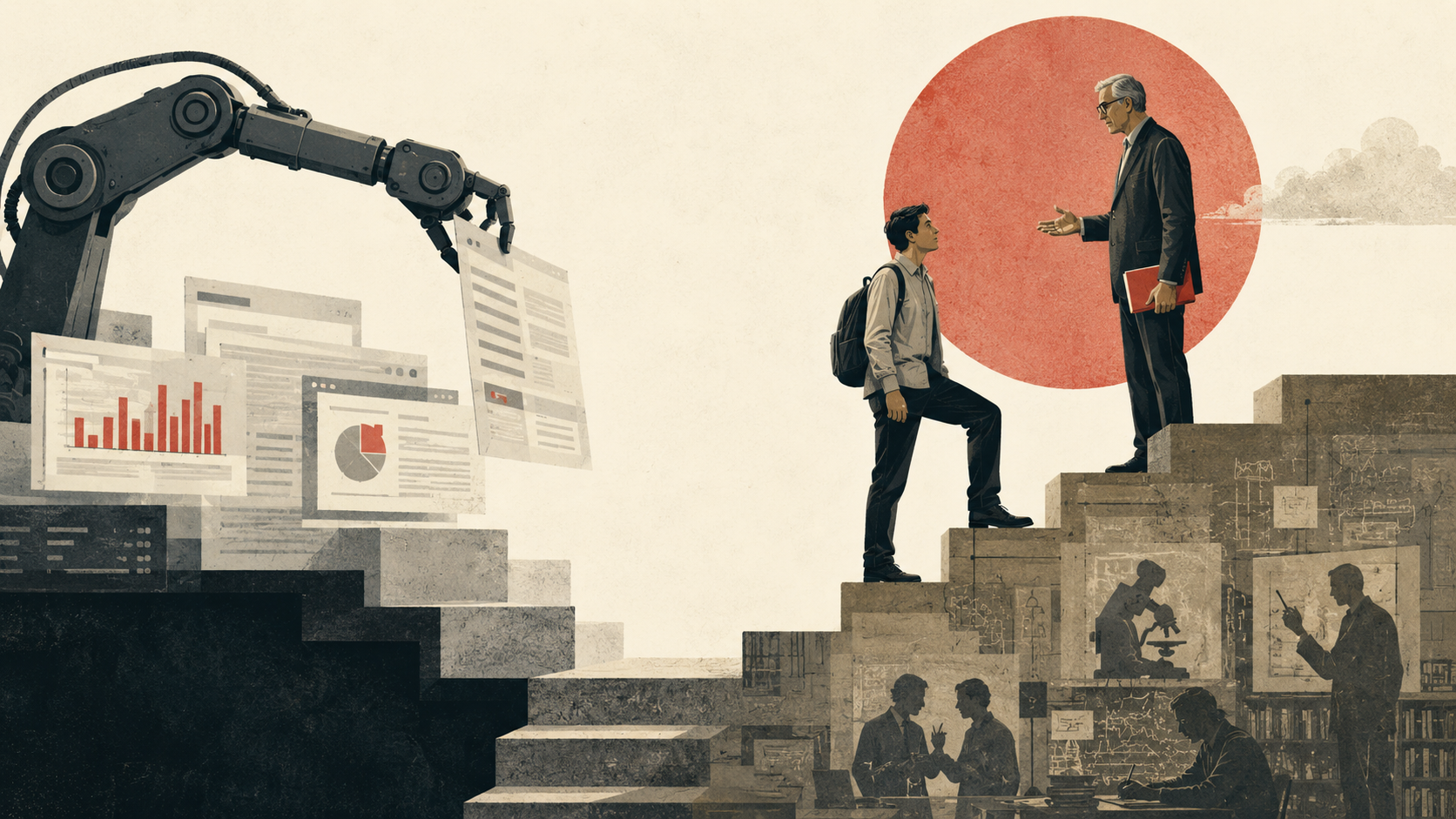
Nicole Junkermann argues that the greatest challenge posed by artificial intelligence is not replacing experts, but preserving the pathways through which expertise is built.
Nicole Junkermann argues that the greatest challenge posed by artificial intelligence is not replacing experts, but preserving the pathways through which expertise is built.
A lot of the debate surrounding artificial intelligence focuses on whether machines will end up relacing highly skilled professionals. Doctors, lawyers, engineers and teachers are frequently presented as examples of occupations that will remain largely protected because they depend upon trust, judgement and human relationships.
That is probably (and hopefully) true. Most people will continue to want a doctor making decisions about their health and a lawyer advising them on important legal matters. Professional expertise remains valuable.
The more interesting question is how future generations acquire that expertise in the first place.
For centuries, professional development has followed a broadly similar pattern. Graduates begin with routine tasks. Junior lawyers review contracts and conduct research. Junior doctors spend countless hours examining patient records and observing senior clinicians. Young engineers solve relatively small problems before progressing to larger ones. Over time, experience accumulates and responsibility increases.
The system is imperfect, slow, and often frustrating. It is also remarkably effective. Many of the activities now being automated by AI were never simply administrative work. They formed an essential part of the process through which professionals learned their craft.
There is a tendency to view routine work purely through the lens of productivity. If software can complete a task in seconds that once required several hours, the economic case appears obvious.
But the purpose of a lot of entry-level work has always extended beyond the immediate output.
A junior doctor reviewing patient notes is not merely processing information. They are learning how symptoms present themselves in practice. A trainee lawyer conducting research is not simply gathering facts. They are developing a deeper understanding of legal reasoning. A young investor building financial models is learning how businesses operate, how assumptions fail and how uncertainty affects decision-making.
These experiences create the foundations upon which professional judgement is built.
As AI systems assume a greater share of this work, organisations face a challenge that receives far less attention than questions of automation or productivity. If fewer people undertake the tasks that traditionally served as professional training grounds, new methods of developing expertise will be required.
The implications extend well beyond the workplace. Educational systems were largely designed for an era in which access to information was limited. Universities played a central role in transmitting knowledge because knowledge itself was scarce.
Today, information is abundant. Students can access explanations, research, tutorials and analysis on almost any subject within moments. Artificial intelligence accelerates that trend further. As a result, the value of education increasingly lies not in access to information but in the ability to understand and evaluate it.
The skills most likely to distinguish successful professionals are becoming familiar ones: critical thinking, intellectual curiosity, communication, reasoning and the ability to operate under conditions of uncertainty. These qualities have always mattered. What is changing is their relative importance.
When information becomes easier to obtain, the ability to interpret and apply it becomes more valuable.
This distinction helps explain why discussions about AI often become confused. Knowledge and judgement are related but they are not the same thing.
Artificial intelligence is exceptionally good at identifying patterns, retrieving information and generating plausible responses. Those capabilities are already transforming many industries. Judgement operates differently. It depends upon context, experience, ethics, accountability and an understanding of consequences.
An AI system can provide ten possible courses of action. Someone still needs to decide which one should be followed. In medicine, law, finance, public policy and countless other fields, that responsibility remains fundamentally human. The challenge is not preserving the role of judgement. It is ensuring that enough people develop the experience necessary to exercise it well.
Every profession depends upon a steady pipeline of new talent. Experienced practitioners eventually retire, move on or leave the workforce. Their replacements need to come from somewhere.
For employers, universities and professional bodies, this is becoming one of the most important questions raised by AI. Efficiency gains are real and should be embraced. But organisations also need to think carefully about how expertise is cultivated when traditional forms of apprenticeship become less common.
The institutions that succeed will be those that recognise both sides of the equation. Deploying AI effectively will matter. Developing capable human beings will matter just as much.
The future is unlikely to be defined by a competition between people and machines. It will be shaped by societies that learn how to combine technological capability with the human skills that tech can’t easily reproduce.
For all the attention paid to what AI can do, the more consequential question concerns what people will still need to learn. The answer will help determine not only the future of work, but the future of expertise itself.
Nicole Junkermann is an international investor focused on technology, sports and media. She leads NJF Holdings, a global investment group, and its sports platform Gameday by NJF Holdings, which invests in sports leagues, media rights and technology-driven fan engagement. Her work in the sector focuses on building long-term sports infrastructure and expanding the commercial and global reach of professional leagues.